
Become the store AI checks out from.
When a shopper tells ChatGPT, Gemini, Perplexity, or Google AI Mode to buy something, one store's products get surfaced, compared, and bought. We make your catalog the one that wins, UCP-ready feeds, schema, and agent readable product data.
The new reality
The checkout moved. Your catalog didn't.
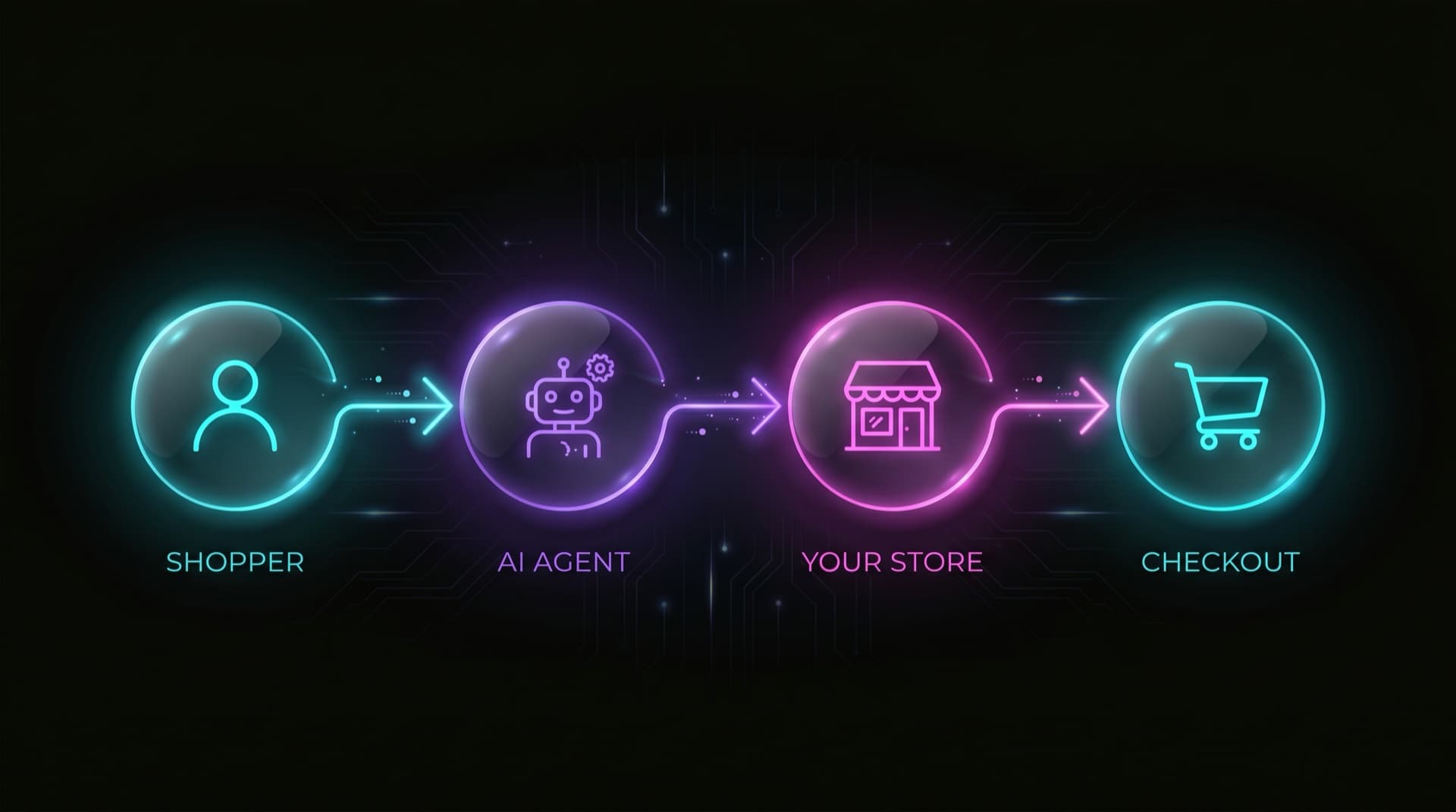
Shoppers used to search, click through to your site, and check out. Increasingly they delegate the whole thing to an AI agent: “find it, compare it, buy it.” The agent reads structured product data, not your landing page, and completes the purchase on the shopper's behalf.
Google's Universal Commerce Protocol (UCP), formalized across Google Marketing Live and I/O 2026, is the open standard that makes this work, the plumbing that lets any AI surface discover, cart, and check out from any store. The catch: fewer than 0.1% of stores are ready for it, and most fail the foundational layer they could fix today.
find me the best trail running shoes under $140, in stock, ships free
Reading product feeds…
<0.1%
of online stores are UCP-ready today, even the giants who co-built it aren't fully live
Industry estimates, 2026
45%
of consumers now use AI tools like ChatGPT, Gemini, or Perplexity to find a local business, up from 6% a year ago
BrightLocal, 2026
$1T+
projected U.S. agentic-commerce spend by 2030 ($3–5T globally) as agents shop on shoppers' behalf
McKinsey, 2026
Plain English
What is UCP, in 60 seconds.
The Universal Commerce Protocol is Google's open standard that lets AI agents discover your products, build a cart, and check out, across Google AI Mode, the Gemini app, and third-party agents, without a custom build for each one. It was co-developed with Shopify, Etsy, Wayfair, Target, and Walmart, and endorsed by 20+ companies including Stripe, PayPal, Mastercard, Visa, Best Buy, and Home Depot.
Two things to know. First: UCP sits on top of your existing product feed, it doesn't replace it, and you stay the Merchant of Record and keep your customer relationship. Second: full agentic checkout is a gated pilot (live in the U.S., rolling out to Canada and Australia). But the foundational layer that decides whether agents can even see and trust your catalog is fixable right now.
The shift
Why most stores are about to go invisible.
When a shopper hands the buy to an AI agent, the agent reads a product feed, not your storefront. If your data is thin, your catalog never makes the shortlist.

Feeds are the new SEO
Agents read your structured product data, not your marketing copy. If your feed and schema are thin, you're invisible to the buy.
The window is open now
Fewer than 0.1% of stores are ready. First movers get surfaced and cited before competitors even start.
You stay in control
UCP rides on your existing feed. You remain Merchant of Record and keep the customer, the agent is just a new storefront.
You don't wait for the pilot
The foundational layer, schema, feed quality, data enrichment, is fixable today, and it's what decides eligibility.
How we compare
Most options stop at a score. We fix it.
The readiness score
One number. Two honest layers.
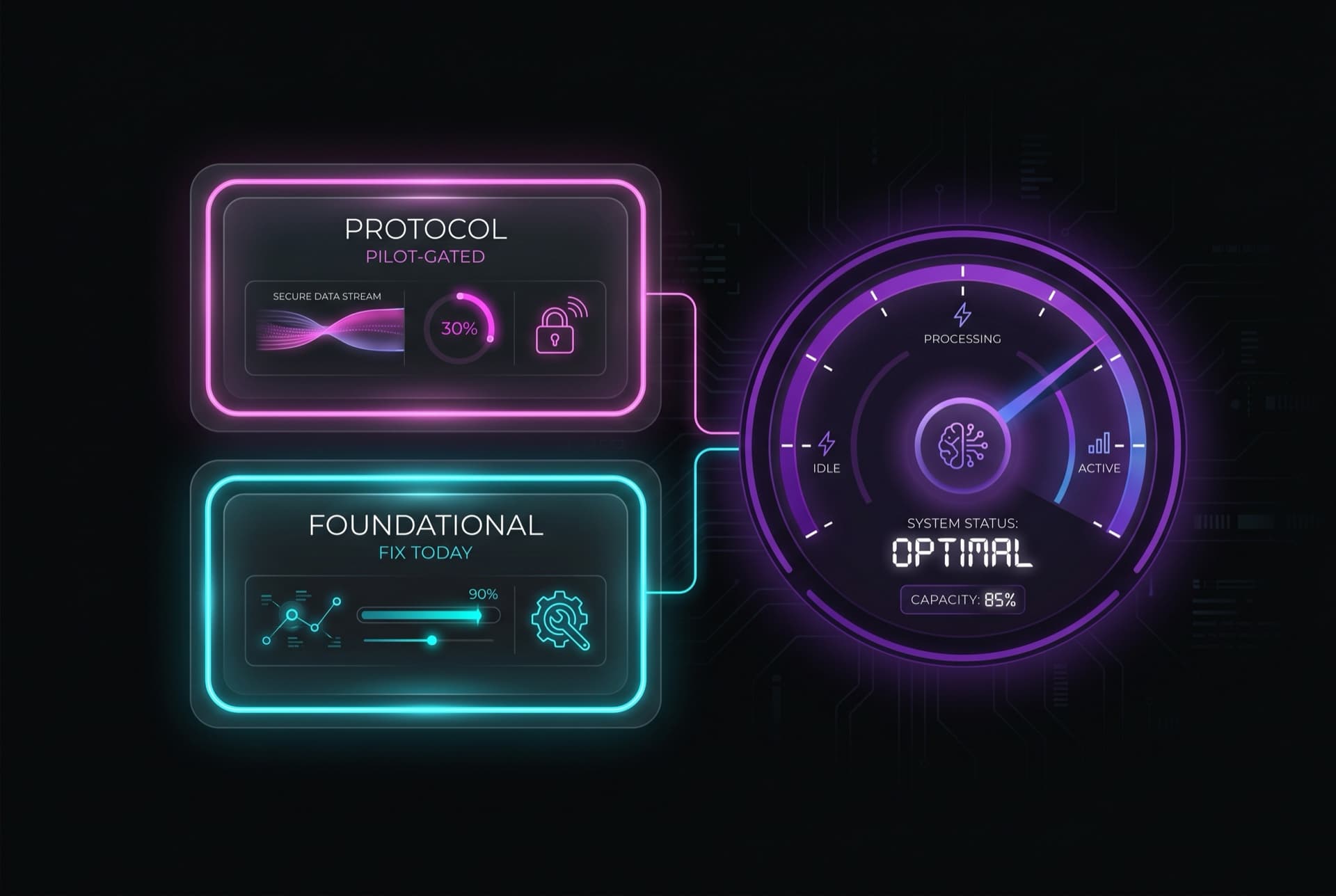
We score your store 0–100 across two layers, the half you can fix today and the half that's pilot gated, so you know exactly what's in your control. We sell readiness, not “certification.”
Foundational
Fixable todayWhat any merchant can fix now, the data and trust signals that decide whether agents can see and recommend your catalog at all.
Product & Offer schema
schema.org Product/Offer on live product pages, price, availability, condition machine-readable.
Real-time price & availability
Structured, current data agents can act on, not buried in JavaScript or marketing prose.
Return policy & support
Discoverable MerchantReturnPolicy + a real contact, Merchant-of-Record basics agents require.
Product-data enrichment
Specs, compatibility, substitutions, certifications, the attributes agents reason on to choose you.
Verified reviews
AggregateRating schema and real review velocity, a core agent ranking signal.
Agent crawlability
Product data reachable without executing client-side JS, many agents don't render it.
Protocol
Pilot-gatedThe UCP-specific plumbing for agentic checkout. Gated by Google's pilot, we prepare it so you're first in line when it opens for you.
/.well known/ucp manifest
A valid UCP profile, services, capabilities (catalog search, cart, checkout), payment handlers, public keys.
OAuth metadata
/.well known/oauth-authorization-server for account-linked checkout, per the spec.
Platform eligibility
Shopify and eligible stacks have a faster native path, we confirm yours and map the route.
Merchant Center standing
Zero disapproved products, free listings on, automatic item updates enabled, feed fresh within 24h.
What we do
The full agentic commerce stack.
AI Commerce Readiness Audit
FoundationalLive-store scan → two layer 0–100 score → the specific fixes, by priority.
Merchant Center optimization
FoundationalClear disapprovals, turn on free listings, set return policy & support, enable automatic item updates.
Product-feed enrichment
FoundationalAdd the agent-decision attributes: specs, compatibility, substitutions, certifications, reviews.
Ecommerce schema implementation
FoundationalProduct / Offer / AggregateRating / MerchantReturnPolicy JSON-LD on your live pages.
/.well known/ucp manifest setup
ProtocolAuthor and host your UCP profile, services, capabilities, payment handler, keys.
UCP pilot-application support
ProtocolComplete the technical build, submit, and prep for sandbox validation.
Agentic-commerce monitoring
ProtocolWeekly tracking of whether agents surface and recommend your products, real outcomes, no vanity metrics.
Agentic commerce, answered
The questions every store owner is asking.
What is the Universal Commerce Protocol (UCP)?
+
UCP is Google's open standard that lets AI agents discover products, build a cart, and check out from a store on a shopper's behalf, across Google AI Mode, the Gemini app, and third-party agents. It was co-developed with Shopify, Etsy, Wayfair, Target, and Walmart and endorsed by 20+ companies including Stripe, PayPal, Mastercard, and Visa. It sits on top of your existing product feed rather than replacing it.
Is my store UCP-ready?
+
Most stores aren't, fewer than 0.1% are. Readiness has two layers. The foundational layer (Product/Offer schema, real time price and availability, return policy, reviews, and agent crawlable data) you can fix today. The protocol layer (a valid /.well known/ucp manifest and Google Merchant Center standing) prepares you for agentic checkout. Our free readiness scan scores both and tells you exactly what to fix.
How do I get my products into Google AI Mode and Gemini shopping?
+
Start with clean, structured product data: Product and Offer schema with machine-readable price and availability, a healthy Google Merchant Center feed with free listings on and zero disapprovals, enriched attributes (specs, compatibility, certifications), and real reviews. That foundational layer is what makes your catalog visible to AI surfaces. The UCP manifest then enables agentic checkout where the pilot is live.
What is /.well known/ucp?
+
It's the UCP profile file an AI agent fetches to learn how to transact with your store, the services and capabilities you support (catalog search, cart building, checkout, order management), your payment handlers, and your public keys. It must be publicly reachable with no authentication. We author and host it for you as part of protocol-layer setup.
Does UCP only work with Shopify?
+
No. UCP is an open, platform-neutral standard, and any eligible stack can implement it. Shopify and a few other platforms have a faster native path, which can shortcut some of the build, but stores on other platforms can become UCP-ready too. We confirm your platform and map the most direct route during the readiness scan.
Will AI agents take away my customer relationship?
+
No, UCP is designed so you stay the Merchant of Record. You keep the order, the customer data, and the relationship; the agent is simply a new storefront that surfaces and completes the purchase. That's a key reason to get ready now rather than ceding the surface to competitors who do.
What's the difference between UCP, ACP, and AP2?
+
They're overlapping standards for agentic commerce. UCP (Universal Commerce Protocol) is Google's standard for agents discovering and buying from stores. ACP (Agentic Commerce Protocol) is associated with OpenAI/Stripe for in-chat checkout. AP2 (Agent Payments Protocol) covers the payment authorization layer. The good news: the foundational work, clean structured product data, makes you ready for all of them, which is where we start.
How much does it cost to get UCP-ready?
+
We scope it to your catalog on a free call, no published one-size price. Most stores start with a Readiness engagement (audit + Merchant Center cleanup + core schema), then move to Agent-Ready (feed enrichment + UCP manifest + monitoring) once the foundation is solid. No contracts; you own everything we build.
Is UCP available in my country yet?
+
Full agentic checkout is a gated pilot, live in the United States, rolling out to Canada and Australia, with the United Kingdom expected to follow. But the foundational readiness work applies everywhere and is what decides eligibility, so getting ready now is worthwhile regardless of where the pilot has reached.
Can a small business compete in agentic commerce?
+
Yes, arguably more easily than in traditional search. Agents reward clean, trustworthy, well-structured product data over ad budgets and domain age, and almost no one is optimized yet. A focused small catalog with excellent schema, enriched attributes, and real reviews can out-surface a larger competitor that ignored the foundational layer.
What does “agent readable product data” actually mean?
+
It means an AI agent can parse your products without rendering JavaScript or guessing: structured Product/Offer schema, current price and availability, a clear return policy, precise attributes (size, material, compatibility, certifications), and verified ratings. If a person needs your live site to understand the product but a machine can't, you're not agent readable, and that's exactly what we fix.
Why should a Texas store care about UCP now?
+
Because the shift is already underway and the field is empty. Consumer use of AI to find local businesses jumped from 6% to 45% in a year (BrightLocal, 2026), agentic checkout went live for the 2025 holiday season, and almost no Texas store is optimized for it. Moving now means getting surfaced and cited before your competitors start, the same first-mover edge that AI Visibility gave our other clients.
The Commerce Growth Engine
Three ways to get ready. One team.
We scope to your catalog and goals on the free scan. No published one-size price, no contracts.
Tier 1
Readiness
Stop being invisible today.
AI Commerce Readiness Audit
Merchant Center cleanup
Core Product/Offer schema
Prioritized fix list you keep
Most popular
Agent-Ready
Get cited and cart ready.
Everything in Readiness
Full product-feed enrichment
/.well known/ucp manifest setup
Monthly AI-citation monitoring
Tier 3
Marquee
Own the agentic shelf.
Everything in Agent-Ready
Managed agentic-commerce program
UCP pilot-application support
Priority catalog citation tracking
Get named by AI
Surfaced in ChatGPT, Gemini, and AI Mode.
Cart ready feeds
Schema and data agents can act on.
You stay in control
Merchant of Record, your customer.
Proof, weekly
Real catalog citation tracking.
How it works
Five steps to an agent ready store.
- 1
01
Free readiness scan
We score your live store against the two layer UCP checklist and hand you a prioritized plan. No cost, no contract.
- 2
02
Fix the foundation
Merchant Center standing, Product/Offer schema, real time price & availability, the layer that decides if agents can see you.
- 3
03
Enrich the feed
We add the attributes agents reason on, specs, compatibility, substitutions, certifications, reviews, so you get chosen.
- 4
04
Prep the protocol
We author your /.well known/ucp profile and ready your pilot application, so you're first in line when checkout opens for you.
- 5
05
Track the citations
Every week we check whether agents surface and recommend your products, and report real outcomes, not vanity metrics.
Free readiness score
Can AI shoppers see your store?
Tell us about your store. We'll score it against the two layer UCP checklist and follow up within one business day with your readiness score and the fixes that matter most, no cost, no contract.
A real human reply within one business day
Two-layer 0–100 readiness score on your catalog
No contracts, month to month, you own everything
FAQ
Working with us.
Do you sell “UCP certification”?
+
No, and be wary of anyone who does. There's no universal certification you can buy; full agentic checkout is a gated pilot. We sell readiness: we score the foundational layer you can fix today separately from the protocol layer that's pilot gated, and we're honest about which is which.
Do I need to be on a specific platform?
+
No. We work with Shopify, WooCommerce, BigCommerce, custom, and headless stores. Shopify has a faster native UCP path, but every eligible stack can become ready. We confirm yours on the free scan.
Do you require a contract?
+
No long term contract. We start with a free readiness scan, then go month to month. You own your feed, schema, content, and accounts.
Are you actually based in Texas?
+
Yes, founded in 2020 and headquartered at 12015 Radium Street in San Antonio. We serve ecommerce brands across San Antonio, Houston, Dallas–Fort Worth, Austin, and beyond.
Be the store AI checks out from.
Book a free 15 minute call. We'll run your store against the UCP checklist and show you exactly where you stand, from San Antonio.