AI Agents Will Do Your Customers' Buying. Here's How San Antonio Businesses Get Chosen
AI agents already research, compare, and book on a customer's behalf, and they choose by reading structured public data, not your ads. Here is how agentic buying works, why most local businesses are invisible to it, and the five things a San Antonio business can do this month to become the one the agent picks.
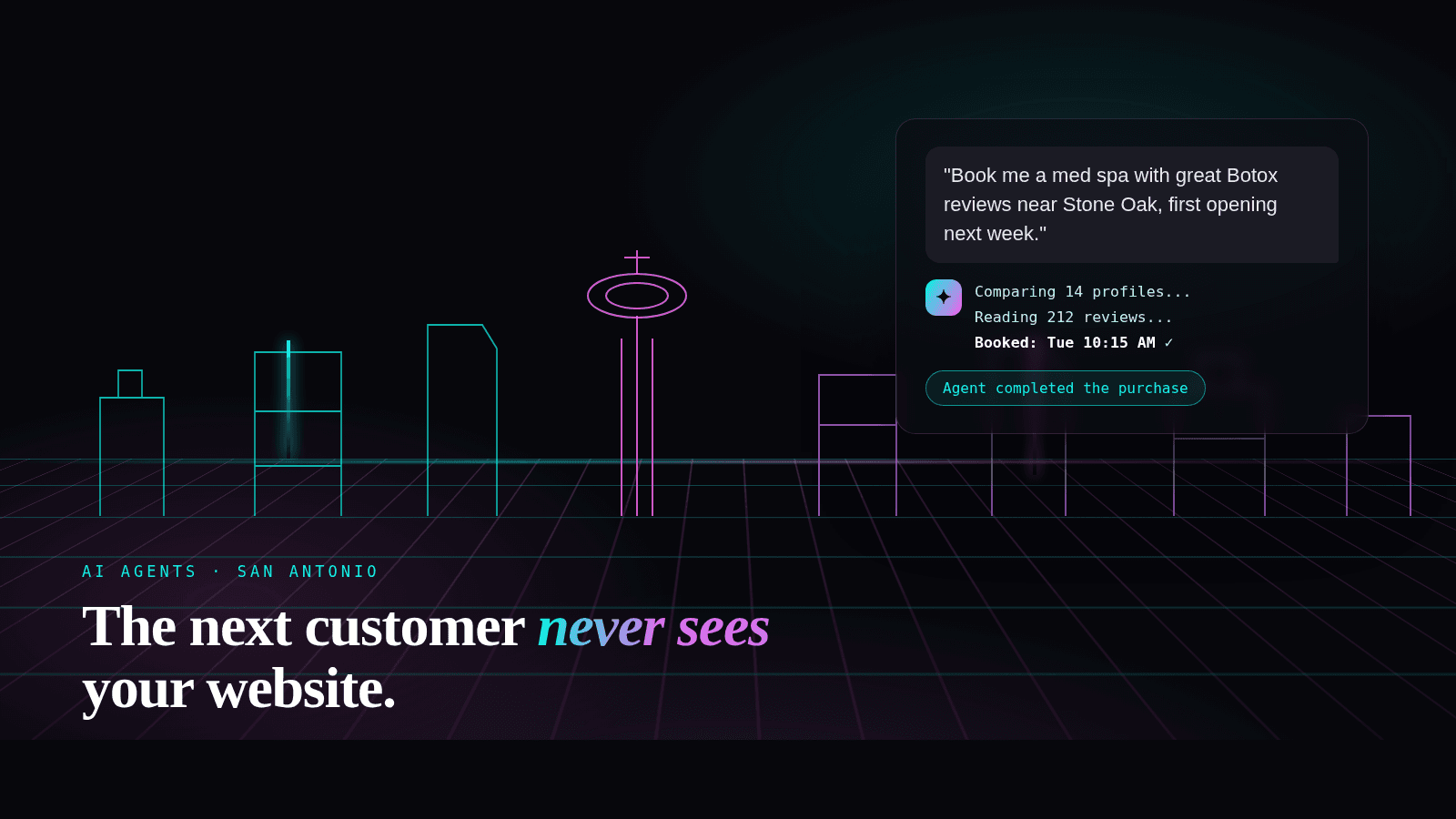
The next customer who buys from you may never see your website. An AI agent will read your public data, compare you to three competitors, and either book you or skip you before a human looks at anything. Agents choose on structured facts: a complete business profile, real reviews with specifics, current hours, honest pricing, and product or service data a machine can parse. Businesses that publish those signals get picked. Businesses that rely on a pretty homepage and a phone number do not.
Something changed in the last year, and most local businesses have not caught up to it yet. People stopped just asking AI for recommendations. They started letting AI act on them.
"Find me a med spa with good Botox reviews near Stone Oak and book the first opening next week." That is one sentence typed into an assistant. The agent does the rest: searches, reads reviews, compares availability, and completes the booking. The customer never opened Google, never scrolled Instagram, never saw a single ad. If your business was not machine readable enough to be evaluated, you were not rejected. You were never considered.
We have been building for this shift since it started, and we wrote this guide because the pattern in our AI visibility work is now impossible to ignore: the gap between businesses agents can read and businesses they cannot is becoming the whole ballgame.
What an AI agent actually does
An assistant answers a question. An agent completes a task. That distinction sounds small and is not.
When a customer asks an agent to handle something, the agent runs a loop that looks a lot like what a careful human assistant would do:
- It interprets the goal, including constraints the customer barely spelled out: budget, distance, timing, quality bar.
- It gathers candidates from search indexes, maps data, business profiles, and review platforms.
- It reads everything available about each candidate, and "reads" means parses. Structured data gets understood. Vague marketing copy gets skipped.
- It compares on the customer's terms, not yours. Price transparency, review specifics, availability, and reliability signals carry the weight.
- It acts: books the appointment, places the order, fills the cart, or hands the customer a single recommendation with one tap left to confirm.
Notice what is missing from that loop. Your branding. Your homepage animation. Your ad budget. The agent never experienced any of it. It experienced your data.
Why most local businesses are invisible to agents
Here is the uncomfortable part. Most San Antonio businesses fail the agent evaluation before it starts, for reasons that have nothing to do with the quality of their work:
- Their hours are wrong somewhere. An agent that finds conflicting hours across your profiles treats you as unreliable and moves on. It will not call to double check.
- Their reviews are generic. "Great service" tells an agent nothing. "They fixed my AC compressor same day for the exact price they quoted" answers three evaluation questions at once.
- Their pricing is hidden. Agents optimize for customer constraints, and budget is almost always one. A competitor with published, honest pricing can be evaluated. You cannot.
- Their services live in a PDF or an image. Menus, service lists, and packages that exist only as pictures are unreadable to most agent pipelines. Machine readable structure is the price of entry.
- Their identity is inconsistent. Different names, addresses, or phone numbers across the web make an agent unsure it is even looking at one business.
None of these are marketing problems in the old sense. They are data problems. Which is good news, because data problems are fixable in weeks, not years.
The five moves that make you the agent's pick
This is the playbook we run on client accounts, ordered by impact for the effort.
1. Make your Google Business Profile boringly complete
Every field, filled in, accurate, current. Hours including holidays, services listed by name, real photos, attributes, and a description written in plain language. The profile is the closest thing agents have to an official record of your business. Treat it like a legal filing, not a brochure.
2. Collect reviews that name specifics
Ask happy customers to name the exact service, treatment, or product in their review. Five reviews that say "Botox" beat fifty that say "great place" when the agent is matching a Botox request. This single habit moves more agent decisions than anything else we have tested. Our is AI recommending your business guide covers the ask scripts we use.
3. Publish honest prices, even ranges
You do not need a full price list. You need enough that an agent can answer "does this fit the budget." A published range with a plain explanation of what moves the number beats silence every time, and it screens out mismatched customers before they waste your phone line.
4. Make your services and products machine readable
Structured data on your site, service pages with one clear service per page, and current schema markup. If you sell products, publish name, price, and availability as data, not screenshots. This is the layer standards like UCP are being built on, and we maintain a plain language breakdown of where that is heading at UCP readiness, plus a deeper dive into the whole space at agentic commerce.
5. Verify what agents currently see, then fix the gaps
Before you change anything, find out what AI already says about you. Ask the major assistants the questions your customers ask. Note where you are absent, where you are named, and what data they cite. That baseline turns guesswork into a checklist. It is exactly what our free audit measures, and the report usually surprises people in both directions.
What this looks like when it works
The end state is simple to describe. A customer tells an agent what they need. The agent reads your complete profile, your specific reviews, your honest pricing, and your structured services. You come back as the recommendation, or the booking just happens, and your first contact with the customer is a confirmed appointment.
That is not a futuristic scenario. It is how a growing slice of local purchases already flows, and the share grows every quarter. The businesses winning right now are not the biggest. They are the most readable.
The window matters too. Right now, most of your competitors have not done any of this, which means the five moves above buy an outsized advantage. In two years they will be table stakes.
If you want to know exactly where your business stands with the agents today, get the free audit and we will show you what AI finds, what it misses, and what to fix first. Or book a strategy call and we will walk through it together.
Written by
Roger Wong Won
Founder of Capture That Media. San Antonio's AI Visibility specialist. Award winning since 2018. Writing playbooks the team uses on real client work.
Working on this? Explore our AI Visibility service.
Free · 15 min · No pressure
Keep reading
All articlesWhat Google Actually Says About AEO and GEO in 2026
Google’s official take on AEO and GEO: for Search it’s still SEO. Unique content, clean indexing, no special AI schema — plus how we measure it in Search Console.
AI Is Getting Your Business Facts Wrong. Here Is How to Fix It
Showing up in AI answers is only half the job. Getting quoted correctly is the other half. When an engine hands out hours you changed two years ago, or a number that rings nowhere, it costs you the customer anyway. Here is where the wrong facts come from, how to find them in fifteen minutes, and the order to fix them in.
The AI Business Operating System: The Field Manual for Teams That Run on AI
Most teams are not bad at AI. They are stuck at the first move: typing a question, getting a paragraph, pasting it somewhere, and calling that adoption. Our new 46 page field manual is the other ninety percent, and it is free to download.