

What is llms.txt?
A two-minute file that hands ChatGPT, Perplexity, Claude, and Google's AI a clean map of your best pages, so they quote the right thing instead of guessing. Here's the plain-English version, a step-by-step setup, a copy-paste template, and an honest take on what it actually does in 2026.
The short answer
llms.txt is a plain-text Markdown file at your domain root (yoursite.com/llms.txt) that gives AI engines a curated list of your most important pages, each with a short description, so they can find, understand, and cite the right content instead of scraping it out of cluttered HTML.

What llms.txt actually is
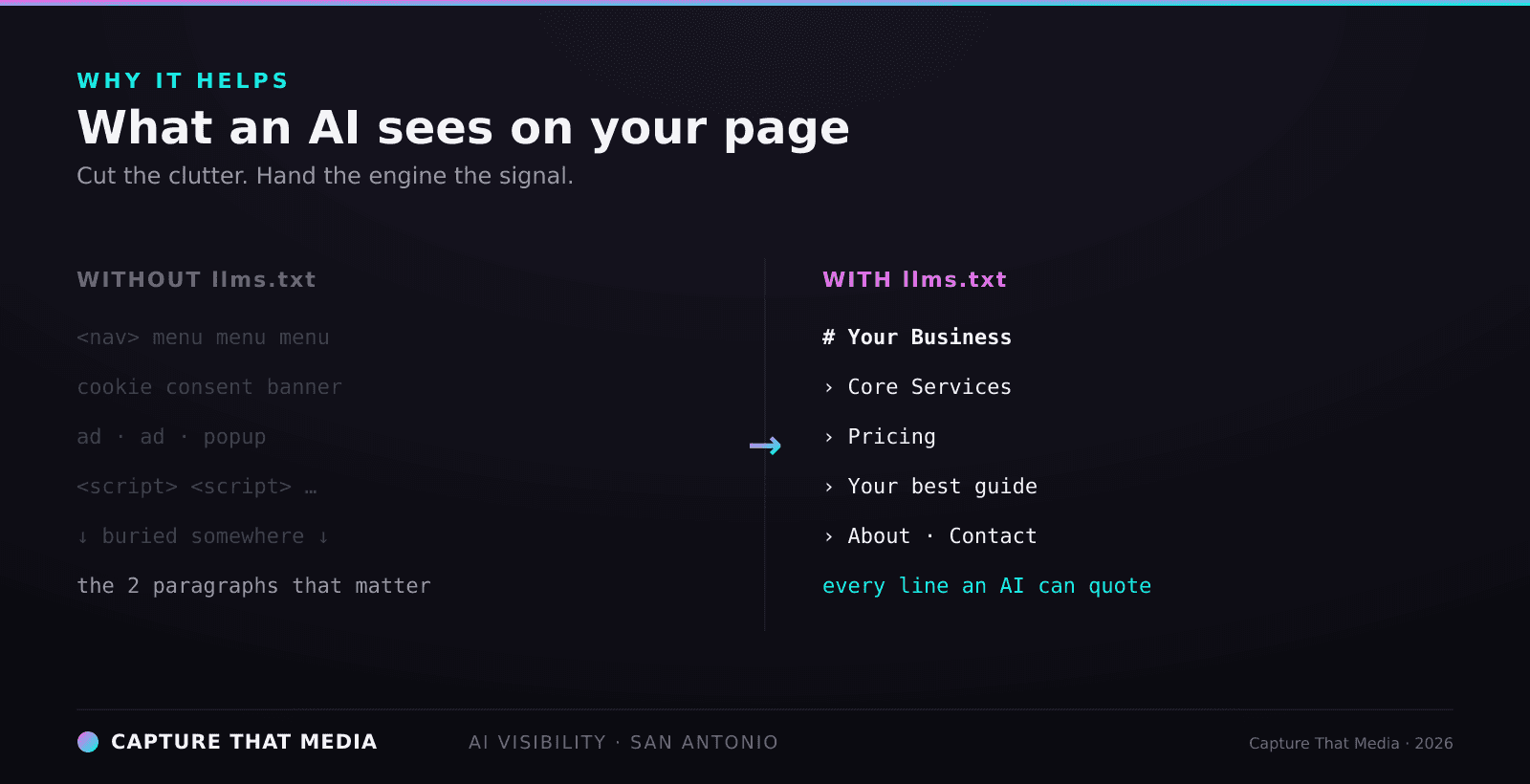
The idea was proposed in September 2024 by Jeremy Howard of Answer.AI and published at llmstxt.org. The problem it solves is simple: a modern webpage is mostly notcontent. It's navigation, cookie banners, scripts, popups, and markup. When an AI model tries to read your site, it has to wade through all of that to find the few paragraphs that matter, and it doesn't always pick the right ones.
llms.txt is your answer to that. It's a short, human-readable Markdown file that says: “Here are the pages I most want you to understand, and here's what each one is.” Think of it as a curated table of contents written specifically for machines, the same way sitemap.xml is a map for search crawlers, but built for the language models behind AI search.
Why it matters in 2026
The early-mover window is open right now.
Adoption crossed an important line this year. By early 2026, companies like Anthropic, Stripe, Cloudflare, Vercel, Zapier, and Hugging Facehad all published an llms.txt, the same pattern you see before any web standard goes mainstream. When Yoast SEO started auto-generating llms.txt for WordPress sites, that's the “early-adopter to default” tipping point that usually plays out over the next 12–18 months.
And yet, by most estimates, only 5–15% of websites have one. That gap is the opportunity: the businesses that publish a clean, accurate llms.txt now are staking their claim before their competitors even know the file exists. This is exactly the kind of early, low-cost signal we build into every AI Visibility engagement.
The honest caveat (most guides skip this)
It's a low-cost bet, not a magic switch.
We won't oversell it. As of 2026, no major AI company has publicly committed to reading llms.txt in production, and studies of real crawler logs show AI bots still mostly fetch your regular HTML and skip the file. If anyone promises that an llms.txt will get you into ChatGPT's answers by next week, be skeptical.
So why bother? Because the downside is basically zero and the upside is real. It takes minutes to make, it can't hurt your SEO, several engines are experimenting with it, and the direction of travel, toward per-page, machine-readable context, is unmistakable. Publishing a clean llms.txt today is cheap insurance and a head start, not a shortcut. The things that actually earn AI citations are still entity authority, structured data, and useful content, which is the real work we do on every AI Citations project.
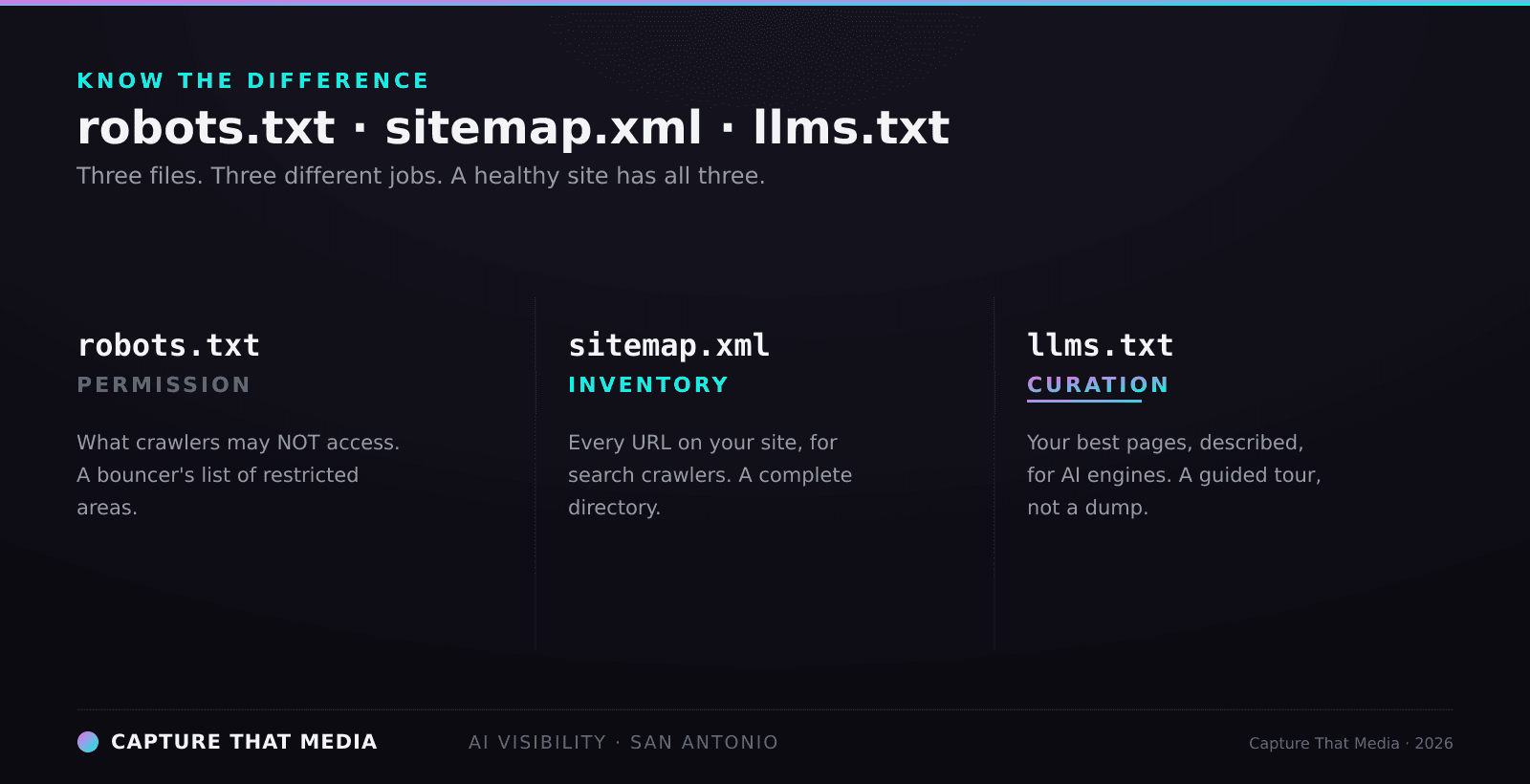
llms.txt vs robots.txt vs sitemap.xml
These three files get confused constantly. They do completely different jobs, and a healthy site has all three.
Step by step
How to create your llms.txt in 15 minutes

List your most important pages
Pick the 10–30 URLs you'd want an AI to quote when someone asks about your business, your core services, your best guides, your about/contact, your pricing. Skip thin, duplicate, or low-value pages. Curation is the entire point.
Write one honest line per page
Next to each link, add a short, accurate description of what's on the page and who it's for. Write it for a smart human, not a keyword stuffer, AI engines are very good at spotting (and discounting) hype.
Structure it as Markdown
Start with an H1 of your brand name, a one-line blockquote summary, then grouped link sections under H2 headings (e.g. ## Core Services, ## Guides). The format below is the llmstxt.org convention.
Save it as /llms.txt at your domain root
Upload the file so it resolves at yoursite.com/llms.txt. On most platforms that's a static file in your public/ folder or a simple route. Optionally add llms-full.txt with the full text of your key pages inlined.
Keep it in sync
A stale map is worse than none. Update llms.txt whenever you launch, retire, or significantly change a key page, and ping the AI crawlers/IndexNow so the change is picked up. This is the step most sites forget.
Free template
Copy, paste, and fill in the blanks
Save this as llms.txt, replace the placeholders with your real pages and descriptions, and upload it to your domain root. That's the whole job.
# Your Business Name

> One sentence on who you are, what you do, and who you serve.
> (City + specialty help AI place you, e.g. "San Antonio AI-marketing agency.")

## Core Services
- [Service One](https://yoursite.com/service-one): What it is and who it's for.
- [Service Two](https://yoursite.com/service-two): What it is and who it's for.
- [Pricing](https://yoursite.com/pricing): How engagements and pricing work.

## Guides & Resources
- [Your Best Guide](https://yoursite.com/blog/best-guide): The problem it solves.
- [Another Useful Post](https://yoursite.com/blog/another): The problem it solves.

## About
- [About](https://yoursite.com/about): Who founded the company and why.
- [Contact](https://yoursite.com/contact): How to reach you, hours, location.

## Optional
- [Full text version](https://yoursite.com/llms-full.txt): Inlined key pages.
Want a tighter one tailored to your business? Our free AI visibility audit includes a custom llms.txt draft.
Case study
We practice what we publish.
Capture That Media runs a live llms.txt at capturethatmedia.com/llms.txt. Go look at it, it's public by design. It leads with who we are in one line (San Antonio's AI Visibility specialist), then curates our service pages, our flagship guides, and our entity home, each with a plain description an AI can quote verbatim.
Curated, not dumped. ~20 hand-picked URLs, not our whole sitemap, the model gets signal, not noise.
Entity-anchored. It points at one canonical “who we are” page so engines consolidate signals instead of splitting them.
Kept in sync. It updates when we ship pages, and our weekly job re-pings the crawlers so changes get seen.
No hype. Every description is accurate. We don't claim awards or results we can't back up, engines penalize that.
It's one piece of a bigger system. We pair it with structured data, third-party citations, and a tracker that checks weekly whether ChatGPT, Perplexity, and Gemini are actually naming our clients. See how that works on the AI Citations Wall and in our guide to how to rank in ChatGPT.
FAQ
Quick answers
What is llms.txt?
llms.txt is a plain-text Markdown file you place at the root of your domain (yoursite.com/llms.txt). It gives large language models, the engines behind ChatGPT, Perplexity, Claude, and Google's AI, a clean, curated list of your most important pages with short descriptions, so they can find and quote the right content instead of guessing from cluttered HTML.
Is llms.txt the same as robots.txt?
No. robots.txt tells crawlers what they may NOT access (it's about permission). llms.txt does the opposite, it highlights what you most want AI engines to read and understand (it's about curation). They solve different problems and you should have both.
Do ChatGPT and Perplexity actually read llms.txt in 2026?
Honestly: not reliably yet. As of 2026 no major AI company has publicly committed to reading llms.txt in production, and AI crawlers still mostly parse your raw HTML. But the file takes minutes to create, can't hurt, and positions you for the per-page machine-readable context that's clearly coming. It's a low-cost bet, not a magic switch.
Where do I put the llms.txt file?
At the very root of your domain so it resolves at https://yoursite.com/llms.txt, the same place robots.txt lives. Many sites also publish an llms-full.txt with the full text of key pages inlined.
Does llms.txt help my Google ranking?
Not directly, it isn't a traditional ranking factor. Its job is AI discoverability and answer-engine optimization (AEO/GEO), not blue-link SEO. The fundamentals that earn AI citations, clear entity authority, structured data, and genuinely useful content, still matter most.
Get found by AI
Want to be the answer AI gives?
An llms.txt is step one. We build the full AI visibility stack, entity authority, schema, citations, and weekly tracking, so ChatGPT, Perplexity, and Gemini name you. Start with a free audit.
Free AI visibility audit
See where you stand.
Fill this out and we'll email you a confirmation, then follow up personally within one business day. Prefer to talk now? Book a free 15 minute call.
Sources & further reading: llmstxt.org (the spec); Anthropic's llms.txt; Stripe's llms.txt. Adoption and crawler figures reflect the most recent industry data available at publication (2026).