
The AI Business Operating System: The Field Manual for Teams That Run on AI
Most teams are not bad at AI. They are stuck at the first move: typing a question, getting a paragraph, pasting it somewhere, and calling that adoption. Our new 46 page field manual is the other ninety percent, and it is free to download.
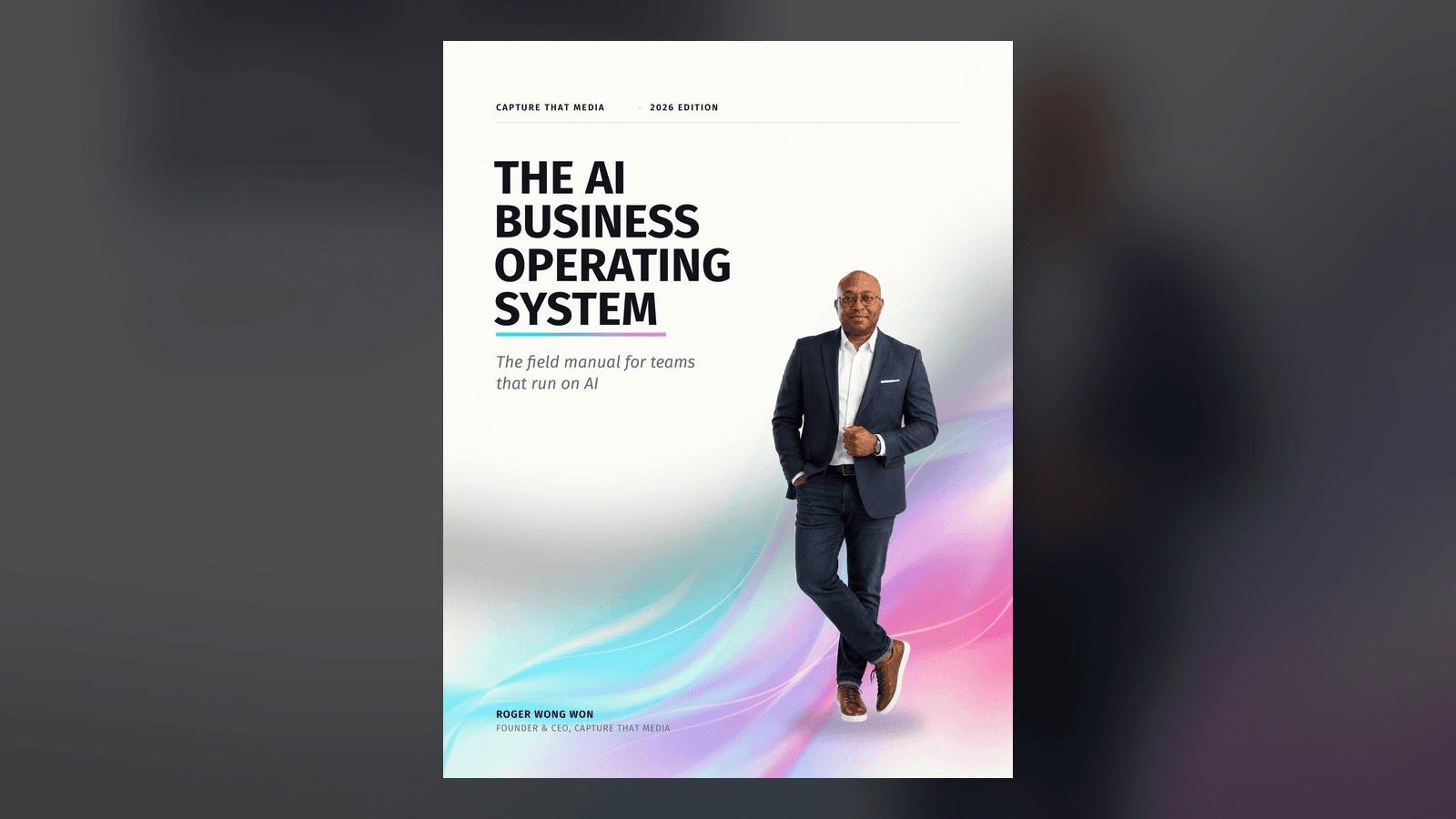
Most teams are not bad at AI. They are stuck at the first move. They buy seats, share a prompt library, and six months later the honest internal answer to whether anything changed is no. The problem is almost never the model. It is operating discipline. We wrote a 46 page field manual covering the four levels of AI use, the five moves almost nobody makes, five operating systems by role, 25 workflows, 15 automations, and a 90 day rollout. It is free, and you can download it below.
Download the manual
The AI Business Operating System (PDF, 46 pages) is free, needs no email, and you can share it freely with attribution.
Written and published by Capture That Media in San Antonio. Every prompt in it is model agnostic and written to survive model updates.
Why we wrote it
There is a gap between what AI can do and what your team actually gets out of it, and that gap is rarely about the model.
We have built AI into client delivery since our founding week, and outside the agency we work with teams trying to do the same thing. In both places the same pattern shows up. A company buys seats. Someone sends around a link to a prompt library. Six months later nobody can point to a number that moved.
What went wrong is not the tool. The team never moved past asking questions. They typed into a box, got a decent paragraph back, pasted it somewhere, and called that adoption. That is ten percent of what they are paying for. The manual is about the other ninety.
The four levels
Every person using AI sits at one of four levels. The level has nothing to do with how smart they are or how much they know about machine learning. It is about the shape of the interaction, and the fix is different at each one.
| Level | What it looks like | Ceiling |
|---|---|---|
| Prompter | One question, one answer, close the tab. Treats the model as a faster search engine. | Saves minutes. Never compounds. |
| Operator | Gives a precise instruction with format, length, and audience. Gets usable output first try. | Saves hours. Still one task at a time. |
| Architect | Chains steps into a pipeline. Output of one becomes input of the next. Reuses the chain. | Saves days. Now a system, not a session. |
| Owner | Builds context once, delegates whole workflows, reviews exceptions rather than every output. | Changes headcount math. |
Most professionals plateau at Operator and assume they have arrived. They write good prompts. They get good answers. And they still do every step by hand.
The jump from Operator to Architect is the single highest return move in the manual, and it is not a skill. It is a decision to stop treating each task as new.
Find your level in ninety seconds
- Open your AI tool and look at your last ten conversations.
- Count how many were a single question with a single answer. That is your Prompter rate.
- Count how many produced something you shipped without rewriting. That is your Operator rate.
- Count how many you would ever open again and reuse.
That last number is almost always zero, and that is exactly the problem. If you cannot point to a single conversation you would reuse, you do not have an AI workflow. You have an AI habit. Habits do not scale across a team and they do not survive the person leaving.
What is inside
The manual runs nine parts, and every section follows the same three beats: Explain gives you the principle, Show gives you the thing itself (usually a prompt you can copy), and Do gives you the specific action to take before you close the file.
- The five moves almost nobody makes. Build context once instead of every time. Ask for the draft you did not ask for. Make it argue with itself. Ask for the decision, not the essay. Give it your actual material.
- Five operating systems by role. Founder, Sales, Content, Operations, and Client Delivery, each with the specific setup that role needs.
- The visibility layer. How AI search decides which businesses get named, and how to run the audit on yourself.
- Twenty five workflows that move real numbers, across strategy, sales, content, operations, and reporting.
- Working with your actual data. The rule of raw, and why you ask for the method before the answer.
- Fifteen automations you can build this month.
- Connectors worth the setup time.
- The ninety day rollout, for teams that need a plan rather than a pile of tips.
- The prompt library.
How to actually use it
Open your AI tool alongside the document. Read a section, run it immediately, then move on. If you only ever read the Do boxes you will still be ahead of most of your competitors.
Reading it cover to cover without touching a keyboard is the least valuable thing you could do with it.
The teams that win with AI are not the ones with the best prompts. They are the ones who stopped starting from scratch.
Get the manual
Download The AI Business Operating System (PDF)
If you would rather have someone build the system with you than build it yourself, that is what we do. Start with a free AI visibility audit, or book a 15 minute call and tell us where your team is stuck.
Written by
Roger Wong Won
Founder of Capture That Media. San Antonio's AI Visibility specialist. Award winning since 2018. Writing playbooks the team uses on real client work.
Free · 15 min · No pressure
Keep reading
All articles →AI Is Getting Your Business Facts Wrong. Here Is How to Fix It
Showing up in AI answers is only half the job. Getting quoted correctly is the other half. When an engine hands out hours you changed two years ago, or a number that rings nowhere, it costs you the customer anyway. Here is where the wrong facts come from, how to find them in fifteen minutes, and the order to fix them in.
AI Agents Will Do Your Customers' Buying. Here's How San Antonio Businesses Get Chosen
AI agents already research, compare, and book on a customer's behalf, and they choose by reading structured public data, not your ads. Here is how agentic buying works, why most local businesses are invisible to it, and the five things a San Antonio business can do this month to become the one the agent picks.
Why San Antonio Is a Great City to Build & Grow a Business (2026)
San Antonio sits inside the world's 8th-largest economy (Texas, ~$2.9T), is the 7th-largest and 4th-fastest-growing U.S. city, and runs 8–10% below the national cost of living. Here's the 2026 data on why it's one of America's best cities to build a business, and how to make sure customers can find you.