We Rewrote Marketing for Engineers From Scratch. Here Is What Died
Most marketing advice aimed at engineers was written between 2015 and 2019, still ranks on page one, and describes channels that closed years ago. We wrote a free 29 chapter replacement and kept a graveyard of every tactic that stopped working.
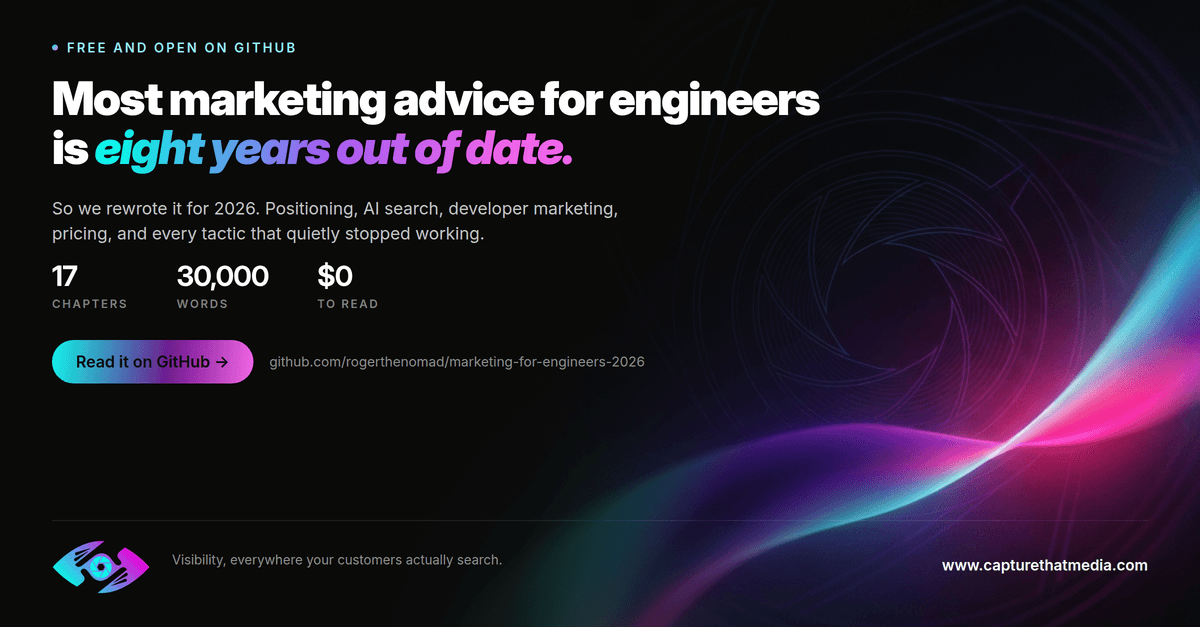
The Visibility Handbook is a free 29 chapter guide to marketing for engineers, technical founders and open source maintainers. It is current for 2026, licensed CC BY 4.0, and built to be forked. The most useful part is not the advice. It is the graveyard: every tool and tactic that stopped working, with the reason it died and what replaced it.
Read it here: github.com/rogerthenomad/marketing-for-engineers-2026
Why we wrote it
We work on AI visibility for a living. Clients ask us where to start, and for years we sent them the same handful of links.
Then we started actually checking those links.
Roughly half were dead. Most of the rest described a platform that had changed underneath the article. A guide to growing on Twitter, written when the API was free. A recommendation to build an audience on Medium, written before the paywall. A chapter on answering questions on Stack Overflow, written before question volume collapsed to levels last seen in 2008.
None of that content was wrong when it was published. It is just old, and it still ranks, so people still follow it and lose months on channels that closed years ago.
Eventually writing the replacement was less work than explaining the problem every time.
What actually changed
Four things moved, and together they invalidate a lot of inherited advice.
Being good is no longer enough to be found
Roughly two thirds of searches now end without a click to the open web. Answers get assembled from passages by systems that may never send you a visitor. The consequence is genuinely disorienting the first time you see it: you can rank first and never be cited, and a page that ranks nowhere can be quoted because one of its sections was the cleanest answer to a sub question.
The best evidence here is from Pew Research rather than any SEO vendor. Looking at the real browsing data of 900 US adults, people clicked a traditional result on 8 percent of pages where an AI summary appeared, against 15 percent where it did not. They clicked a source cited inside the summary on 1 percent of visits.
Your first reader is often not a person
A coding agent reads your documentation, resolves your package name, and picks your library before a human sees your homepage. That makes machine readable surfaces a distribution channel rather than a technical nicety.
It also makes several long standing habits actively harmful. Gated content and book a demo walls now block an evaluation you never learn about, because an agent cannot fill in your form and the developer who delegated the research simply picks the tool that documented itself in public.
The cost of being generic went to zero, and so did the value
Anyone can generate a competent blog post now, a plausible landing page, forty variations of an email. Which means none of those differentiate anything.
What still works is what a model cannot produce: your data, your incident, your benchmark, your opinion with your name on it. That is genuinely good news for engineers, because you have the raw material and most of your competitors do not.
Some old tactics are now enforcement matters
Fake reviews, undisclosed endorsements, bought upvotes and astroturfed threads moved from distasteful to regulated, with civil penalties attached. Guidance written before that shift will get you in real trouble, and it is still sitting on page one.
The graveyard
This is the section we would read first, and it is why the handbook exists.
Some of what is buried in there:
Dead outright. Alexa.com web analytics, retired in 2022. Nuzzel. Siftery. Pablo by Buffer. The entire free Twitter analytics category, killed by API repricing. The whole cohort of one person Product Hunt directories, which has near total mortality.
Actively harmful to link. Social Mention was a genuinely good free tool. Its domain now resolves to a service selling fake engagement. Anyone still linking it from an old list is sending readers somewhere unpleasant.
Collapsed in value. Medium as a distribution engine. Quora. Facebook Pages organic reach. X for link distribution. Stack Overflow as a place to reach developers.
Alive but no longer what they were. Typeform cut its free tier drastically. Hootsuite removed its permanent free plan. BuzzSumo moved upmarket. Copyscape still works for verbatim duplication but cannot detect paraphrased or AI rewritten text, which is now the dominant case.
Removed on principle. A well known 2017 growth hack compendium built almost entirely on LinkedIn and Facebook automation, every channel of which is now closed or a ban risk. And one cold email agency whose founder pleaded guilty in a multi billion dollar money laundering case.
What is in it
Twenty nine chapters, organised by the problem you are actually trying to solve rather than by channel.
Foundations covers positioning, pricing, and naming a product without creating a rename you cannot afford. Getting found covers zero budget growth, content, AI search, launching, community, video and events. Selling to engineers covers developer marketing, open source growth, founder led sales, and treating security reviews as a marketing surface. Then conversion and retention, then analytics, ethics and privacy law, then fundraising, press and hiring.
Six of those chapters cover ground that general marketing guides skip entirely, which is a large part of why their advice bounces off technical audiences.
How we handled the numbers
One editorial decision shaped the whole thing: where we could not trace a statistic to a primary source, we cut it rather than repeating it.
That removed a surprising amount. Product Hunt upvote thresholds. Hacker News front page rates. Reddit ad benchmarks. Several widely quoted pricing shifts. All of it circulates constantly and traces back to nothing.
The clearest example is in the retention chapter. Almost every piece of retention content repeats that it costs five times more to acquire a customer than to keep one. We went looking for the source. There isn't one. It gets attributed to several places, none of which contain it. So the handbook says so, and makes the argument without it.
Where a study comes from a vendor selling the thing it measures, the text says so. That is not a criticism of vendor research, some of which is excellent. It is just information the reader needs.
It is yours
The handbook is free, licensed CC BY 4.0, and built to be forked. Translate it. Specialise it for your stack, your industry, your region. Strip out what does not apply and add what does.
If you build something substantial on top of it, open an issue and we will link to it from the repository.
Corrections are the most valuable contribution you can make. Link rot is the thing that kills a resource like this, which is why there is an automated link checker running against it monthly. Anything about law, privacy rules or email deliverability gets fixed fast, because people make real decisions on that material.
Read The Visibility Handbook on GitHub
If you want to know where your own business currently shows up when someone asks an AI assistant about your category, that is the thing we measure. Get a free AI visibility audit.
Written by
Roger Wong Won
Founder of Capture That Media. San Antonio's AI Visibility specialist. Award winning since 2018. Writing playbooks the team uses on real client work.
Working on this? Explore our AI Visibility service.
Free · 15 min · No pressure
Keep reading
All articlesIs SEO Dead Because of AI? What San Antonio Businesses Should Do in 2026
No, SEO is not dead. The click moved. AI answers still pull from pages search engines can crawl and trust. Here is the three-layer plan we use, plus a 15 minute self-check.
What Google Actually Says About AEO and GEO in 2026
Google’s official take on AEO and GEO: for Search it’s still SEO. Unique content, clean indexing, no special AI schema — plus how we measure it in Search Console.
AI Agents Will Do Your Customers' Buying. Here's How San Antonio Businesses Get Chosen
AI agents already research, compare, and book on a customer's behalf, and they choose by reading structured public data, not your ads. Here is how agentic buying works, why most local businesses are invisible to it, and the five things a San Antonio business can do this month to become the one the agent picks.